 As the “hero” of the Book of Job illustrates, the life of the believer is often beset with difficulty—even, and perhaps often, great difficulty. This is the way of human life in a fallen world, and as Job and many others illustrate, a living faith provides no immunity from undergoing such difficulties. Though God has promised “that in everything [he] works for good with those who love him” (Rom 8:28) so that we can ultimately rest secure in him (see Rom 8:18–21), he does not guarantee freedom from bodily pain and spiritual sorrow. This problem, the problem of suffering, is the knife’s edge of the problem of evil, for it is evil, both natural and moral, that brings suffering upon us. But how do we bear such suffering and its source in the evil we find both in ourselves and in one another? And how do we learn to live a good life in the face of evil and suffering—a life filled with hope and love, a life oriented toward God?
Faith Secured
Of course, the answer is to be found in the Catholic faith—that is, in our faith in Jesus Christ and his Mystical Body, the Church. In the practice of our faith, we learn—sometimes slowly, sometimes swiftly—to cling to Christ in his Church and thereby to receive his gift of redemption. This gift can then become increasingly effectual as we deal with life’s inevitable vagaries, and we can even begin to participate in Christ’s holiness and live a life of friendship with God. But, as Jesus counsels us, in order to enter into his salvific company we must daily deny ourselves, take up our crosses, and follow him (see Mt 16:24). Just so, we learn to humbly surrender to his love and begin to experience the intimacy of his presence. This is the way of Christian life, a way St. Teresa Benedicta of the Cross (Edith Stein) calls “the science of the cross.”[1] It is an unusual science inasmuch as it is never learned in a general and theoretical way but only ever in a singular and existential way—it is a science learned only by the individual, and only individually. And it is precisely by remaining close to Christ in this way, by clinging to him in the difficulties of life, that we begin to learn how to suffer well in the face of evil.
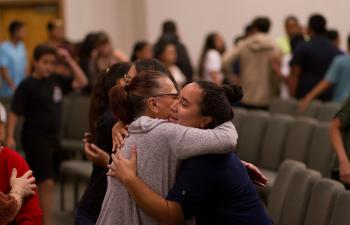
Yet, every believer worth his salt knows this already, for every Christian knows that God loves him and that he must unite his particular cross to Christ’s. But a difficulty presents itself here. When we experience the suffering that follows upon natural and moral evil, when we are in pain and are sorrowful, we can begin to waver in our practice of the faith. Though we may perhaps think we are secure from such problems, that these difficulties are only for the weak of faith, none of us are really so secure that we are exempt from this temptation—which we ask the Father to “lead us not into” (see Mt 6:13). It is generally true that when we are hurt by evil and suffer its cost, we can often get annoyed and cover over our hurt with defensive anger; with anger comes the possibility of growing frustrated with life and its difficulties; if the frustrated anger is chronic, we can become entrenched in resentment and bitterness; and finally, we may begin to struggle to believe in a truly good God and may even doubt his existence.
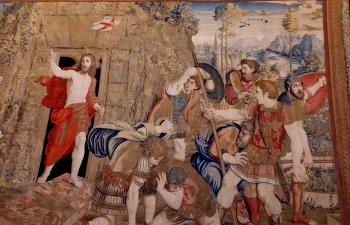
Now, it is right here, at this point of struggle, that we find a most biting existential question. When we face evil and are filled with its suffering, we are questioned, so to speak, by its presence. It says to us, “Is God still good? Even now, while I suffer?” And again: “Does a good God even exist? If he is good, how could he let this awfulness happen to me?” But how are we to handle this difficulty, a difficulty we all face, or at least will face? When our faith is tested and evil begins to rattle its very foundations, perhaps tempting us toward disbelief, how do we withstand this trial and bolster ourselves against such a temptation? In a way, the answer is simple: Christ has suffered for me and with me; Christ has conquered evil and borne the weight of my suffering. Or, in the words the beautiful paschal troparion of the Byzantines, “By death he conquered death, and to those in the grave, he granted life.”[2]
Yet, when we suffer, since we can also evidently stumble, we would be wise to secure our faith and that of others against this patent threat to the life of faith—which, ultimately considered, is the only real threat. There are numerous ways within the practice of the faith itself to fortify the individual against evil and suffering, but there is also something external to faith strictly considered that supports its integrity: its foundation in natural knowledge of (not belief in) the existence of the good God.
Properly speaking, assent to the truth of the existence of God and his goodness are not articles of faith. Though the individual believer can rely on faith to accept these truths, they are actually knowable in a purely natural way, through reflecting on the nature of the world and its creatures. Indeed, this possibility is itself something revealed, for example, when St. Paul says, “What can be known about God is plain to them, because God has shown it to them. Ever since the creation of the world his invisible nature, namely, his eternal power and deity, has been clearly perceived in the things that have been made” (Rom 1:19–20; see also Ps 19:1–6). This scaffolding of natural knowledge of God supports the supernatural act of faith so that the believer’s faith is rightly substantiated and appropriately coordinated (a particular application of the dictum “grace perfects nature”[3]).
In light of this possibility, we could reflect on the Western tradition’s numerous philosophical demonstrations of the existence of God, those of Sts. Thomas, Bonaventure, and Anselm, together with many others. But for this article, allow me to take all these proofs for granted in order to look a little closer at the reality of creation itself—that is, the startling fact of being a creature created by the Creator. This is an awesome reality, and one well worth pondering at length.
The rest of this online article is available for current Guild members.
This article is from The Catechetical Review (Online Edition ISSN 2379-6324) and may be copied for catechetical purposes only. It may not be reprinted in another published work without the permission of The Catechetical Review by contacting [email protected]