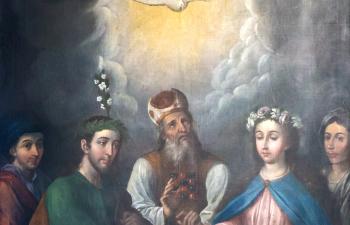
 "When Jesus saw his mother and the disciple there whom he loved, he said to his mother, ‘Woman, behold, your son.’ Then he said to the disciple, ‘Behold, your mother.’ And from that hour the disciple took her into his home” (Jn 19:26–27). In this passage from John’s Gospel, Jesus extends Mary’s motherhood not only to John but symbolically to the whole Church. She is both Mother of our Redeemer and Mother of the Church. This dual role provides an example for mothers to live out the maternal vocation of women with Christian joy. In the domestic church, as a mirror of the activity of the universal Church, Christian parents extend the family’s life of prayer from the Mass and propel it toward the Mass. The role of the mother as source of nurture and nourishment is particularly important in the life of a child. Her maternal vocation also carries a spiritual significance rooted in the priesthood of the baptized; motherhood is understood in relation to the sacrifice of the Mass. What can we learn from Mary as Mother of God and Mother of the Church? What does the Catholic liturgical imagination offer us to inspire us to pursue a deeper relationship with Christ in our life and baptismal call?
God’s Maternal Characteristics
In a collection of essays on the nature and vocation of women, St. Edith Stein writes on the vocation of woman as mother. She understands that the whole of a woman’s existence is, in its entirety, motherly—regardless of whether a woman has borne children in the natural sense. This motherliness extends to everyone a woman encounters. The archetype for this vocation is found in Mary, she writes, and “every woman who wants to fulfill her destiny must look to Mary as ideal.”[1] This maternal calling takes on spiritual and supernatural significance especially in the context of the Sacred Liturgy and the domestic liturgy, as we seek in our family life to “enkindle the sparks of love for God, or once enkindled, to fan them into greater brightness.”[2]
What are these maternal characteristics of woman? These qualities of motherhood—whether one is a mother by birth, adoption, or spiritual motherhood—find their source in God. The image of the maternal characteristics of God is not new; we find examples of it throughout salvation history, from the time of the Old Testament all the way through to the writings of the early Church and medieval saints.[3] The purpose here is not to propose a feminization of God the Father, nor to diminish the significance of the role of the human father in the liturgical life of the family. Rather, God is the source of all goodness, including the goodness of motherhood, and woman is in some manner a reflection, an image, of these nurturing, protecting, and loving maternal qualities.
Sacred Scripture offers numerous representations of motherhood focused on the nurturing care of children, particularly in the book of Isaiah. “Can a mother forget her infant, be without tenderness for the child of her womb?” (Is 49:15). We also hear of the comfort that God will provide in Jerusalem: “As a mother comforts her child, so I will comfort you; in Jerusalem you shall find your comfort” (Is 66:13). Perhaps even more striking is the comparison of the Lord crying out like a woman in labor (Is 42:14). The Psalms, too, employ this image of a nursing mother: “For you drew me forth from the womb, made me safe at my mother’s breasts” (Ps 22:10), and “Like a weaned child to its mother, weaned is my soul” (Ps 131:2). Another frequent theme is the analogy of the animal mother protecting her young: the mother bird that gathers her young, providing shelter under her wings: “He will shelter you with his pinions, and under his wings you may take refuge” (Ps 91:4).
St. John Paul II wrote on the masculine and feminine qualities of God in his apostolic letter Mulieris Dignitatem: “In various passages the love of God who cares for his people is shown to be like that of a mother: thus, like a mother God ‘has carried’ humanity, and in particular, his Chosen People, within his own womb; he has given birth to it in travail, has nourished and comforted it (cf. Is 42:14; 46:3–4). In many passages God’s love is presented as the ‘masculine’ love of the bridegroom and father (cf. Hosea 11:1–4; Jer 3:4–19), but also sometimes as the ‘feminine’ love of a mother.”[4]
Liturgically, this image is expressed in the entrance antiphon for Divine Mercy Sunday, Quasi Modo Geniti Infantes: “Like newborn infants, you must long for the pure, spiritual milk, that in him you may grow to salvation, alleluia.”[5] St. Augustine presents maternal love in the tenderness and care with which a mother feeds her child, describing this life-giving spiritual food: “For this name, according to Thy mercy, O Lord, this name of my Saviour Thy Son, had my tender heart, even with my mother's milk, devoutly drunk in and deeply treasured.”[6] At the same time, Augustine also describes a mother’s milk as the food of the infant, that preparatory spiritual food until solid food can be eaten.[7] Referencing Paul’s letter to the Corinthians (1 Cor 3:1–2), Augustine sees this change in nourishment as a sign of spiritual maturity. From a mother, this is the early nourishment in faith; from God, this is the food of creation, the food that sustains man in existence; and from the Church, this is the spiritual milk of the sacraments.
The rest of this online article is available for current Guild members.
This article is from The Catechetical Review (Online Edition ISSN 2379-6324) and may be copied for catechetical purposes only. It may not be reprinted in another published work without the permission of The Catechetical Review by contacting [email protected]