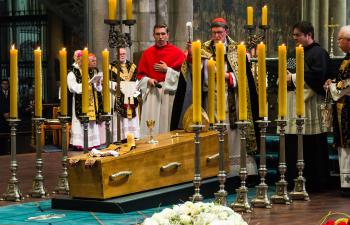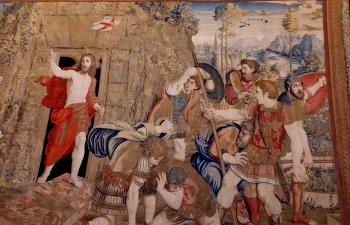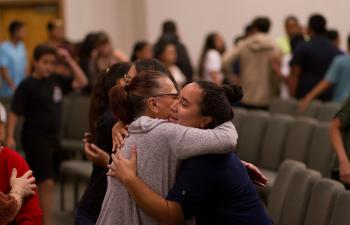
 None of us wants to suffer. We don’t want to be diagnosed with a disease. We don’t want to experience loss.But suffering is inevitable. When it comes, what are we to do? Is it merely to be endured? What, if anything, can we learn from Jesus and his experience of suffering? What does his response to suffering mean for us, who are joined to him in baptism?
The Priesthood of Jesus
Jesus is the eternal Son of the Father. He is the divine Teacher and our model of holiness. The Letter to the Hebrews tells us that he is also a priest, our great High Priest, making of his entire life—but especially his Paschal Mystery—a sacrifice to the Father (see CCC 662; Heb 7; 9:11–15). If we are baptized into Christ and joined into union with him, then the fact that he has a priestly identity and mission means something significant for us.
In the baptismal liturgy, these words are spoken over the newly baptized person: “He [God] now anoints you with the Chrism of salvation, so that you may remain as a member of Christ, Priest, Prophet, and King, unto eternal life.”[1] The ritual text indicates that every baptized person possesses a priestly identity and mission, which centers around the offering of sacrifice. From this point on, our lives are meant to be sacrificial. At Mass, those who are priests by baptism gather around the one who is a priest by ordination, who stands in the person of Jesus, and we all as the assembled body of Christ offer the sacrifice of Jesus to the Father.
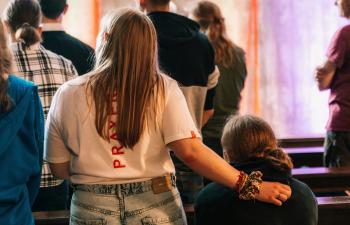
Yet, there is another offering that we priests (by baptism) make in the liturgy. While every facet of the life of the baptized person is capable of being offered to God as a gift, our suffering can also be offered to God. Let’s consider here what would be required for suffering to be experienced and turned over to the Father as a priestly offering.
I’d like to suggest that there are three steps to suffering in a way aligned with our missionary identity. Each of these movements is needed if our sufferings are to be experienced as truly ours and if we are to be conscious and present to them so that they might be given to the Father as a gift.
Stepping into the Experience Itself
The first movement in this sacrificial dynamism is to be interiorly present to our suffering, to be alert to it. Tribulation of any kind is, on the one hand, inescapable for us human beings and, on the other, an experience that can be instinctually pushed away. Our first priestly movement, then, is to not immediately seek diversion but instead be as present to it as we can. We Christians shouldn’t impulsively run from experiencing suffering. Jesus himself said, “Whoever does not take up his cross and follow after me is not worthy of me” (Mt 10:38).
There is another reason why we shouldn’t immediately turn away from the experience of suffering: We are not alone in it. God himself desires to deeply enter into the experience of our suffering with us. While we know that, ultimately, he wants to draw good from our suffering, this doesn’t mean that he is only concerned with outcomes. Rather, he enters in. It is in this desolate place where he may be found. And finding him there can bring about both intimacy with him and the strength we need.
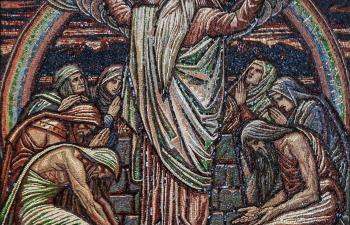
When it came to his own suffering, the Gospels reveal that Jesus not only truly drank the full chalice of suffering, he was alertly present to it before it began. Indeed, he anticipated his own suffering in advance of the events which led to his suffering and death. Numerous times he warned his disciples that he was soon to be taken from them (see Mt 16:21–23; 17:22–23; Mk 9:30–32; Lk 9:44–45). And when he was finally nailed to the Cross, the Nicene Creed poignantly tells us that “he suffered death.”
The Need for Acceptance
Second, we must accept the reality with which we are faced. To be clear, this does not preclude us from pursuing a solution, which is frequently important. We can, though, in the present moment, move toward accepting our circumstances. If we are going to somehow offer our suffering, in some manner the experience has to be ours to offer.
Depending on what we are experiencing, this, of course, can be quite difficult for us to do. This is especially so when the pain or anguish is acute and we feel alone. We might feel that our suffering is unjust. We might cry out to God, “Why are you allowing this?” or, “I don’t deserve this!” or, “Please, Lord, take this away!” When we are in anguish, emotions are strong and raw. Consequently, what I am proposing—taking upon ourselves a posture of acceptance—will not be easy to do. It is a significant milestone to be able to say to oneself as much as to the Lord: “This is my current situation and I accept it.”
Turning to Others in Our Need
Unquestionably, we human beings will frequently need help in moving ourselves into this interior space. Drawing upon good friends who have acquired wisdom in their own suffering can be especially helpful in moving toward acceptance. Friends who understand the Catholic insight into suffering can support and embolden us, which is such a tremendous blessing (for us and for them).
There is a second, infinitely more significant source of assistance we need. We can also turn to God for help in accepting the reality in which we stand. He surely knows well this terrain of suffering.
Certainly we can reach out to him and ask him to deliver us—and sometimes he will! But in my experience, frequently he chooses to not rescue us. This can be puzzling and painful for us to accept. “If he loves me,” we can ask, “why does he allow this in my life?” To this question there are no pat, easy answers. In some way, the suffering person who continues to suffer, even after asking the Lord to extricate him from suffering, has a choice to make.
When God doesn’t answer our prayer for immediate deliverance, how will we respond? Some might turn away from him in bitterness, not understanding God’s silence and apparent inaction. And in our desolation, we can certainly understand such a response. Yet, if we are interiorly able to move toward Jesus, it becomes possible for us to open the hidden parts of ourselves to the Lord amidst our anguish and suffering. And this can be the most profound and intimate of experiences, making possible a deep communion and friendship with him.
Coming to see that our Lord delights in drawing especially close to those who suffer is to learn something about his heart for us. Knowing his profound compassion for those who suffer, and becoming alert to his presence in our own suffering, can be a catalyst for significant spiritual growth.
 The reality of a crucified God is remarkable. When we seek Christ on the Cross in our prayer—when, for example, we pray the Sorrowful Mysteries of the Rosary or the Chaplet of Divine Mercy, or invest ourselves into a course of spiritual reading, and each and every time we participate in the sacrifice of the Mass—we are seeking to be present to our Lord in his suffering love. We can be assured that our generosity to God in this desire will not outshine his generosity to us. To an infinitely greater degree, he, too, wishes to draw close to us. And knowing the Lord’s close presence to us in our suffering with his accompanying grace, especially through the sacraments, we know that he gives us a supernatural capacity to do what is naturally very difficult: to accept whatever has happened to us.
A Sacrificial Gift
Once we have accepted our particular experience of suffering, we are ready to offer it as a gift, a sacrifice, to God. In accepting the experience, it has been embraced as our own, and we are then capable of offering it. It is as if we can take it up into our hands and freely give it to God.
This action, joined to the kenotic offering of Christ, becomes salvific. That is, our offering, because it is joined to his, becomes a catalyst of grace in the world. To be clear, all of the power for the world’s salvation comes from the Cross of Christ, which is our spes unica, our only hope. But he desires to lift us up into this saving action so that we might share with him this work of glorifying the Father and sanctifying the world. How infinitely valuable the priestly offering of our suffering becomes! In this way, the bedridden sick person can become, by her free will and this closeness of Jesus, a significant protagonist in the battle against evil and the culture of death.
We as baptismal priests can offer our sufferings to the Father through the Son in the Holy Spirit. But we can also offer every part of our life as a gift to God. Such an offering can be made by the Christian throughout the day and in the midst of ordinary life. A morning and evening offering can be immensely helpful in assisting us practically to be conscious and alert and consistent in living our priestly identity on a daily basis. More than this, frequently attending Holy Mass will play an unparalleled role in our priestly work. The Second Vatican Council tells us: “Together with the offering of the Lord’s body, [our sacrifices] are most fittingly offered in the celebration of the Eucharist.”[2] In the Mass, we offer the sacrifice of every part of our life, sufferings and all. These sacrifices are joined to the sacrificial gift that Jesus makes of himself, and both of these make up the one sacrifice offered by the one who stands in the person of Christ, who is our great High Priest.
Jesus himself demonstrated these integral movements of priestly sacrifice. He was aware and alert to sufferings. He accepted them. From the Garden of Gethsemane his extraordinary words resound: “My Father, if it is possible, let this cup pass from me; yet, not as I will, but as you will” (Mt 26:39). And then, of course, from the Cross he was able to say to his Father, “Into your hands I commend my spirit” (Lk 23:46) and “it is finished” (Jn 19:30). With these words, the great sacrifice of self-emptying Love that stands at the center of history was accomplished.
This priestly life into which we are baptized, in the end, is a participation in divine life. God is love, and to love divinely means to perpetually give oneself away. Our baptism gives us the capacity for this deep life of sacrificial love—to offer every aspect of our lives to the Father, including our sufferings. This upward movement of love glorifies the God who is love, and it has an extraordinary capacity to contribute to the healing and renewal of our fallen world.
Dr. James Pauley is Professor of Theology and Catechetics at Franciscan University and author of two books focused on the renewal of catechesis: An Evangelizing Catechesis: Teaching from Your Encounter with Christ (Our Sunday Visitor, 2020) and the revised edition of Liturgical Catechesis in the 21st Century: A School of Discipleship (Liturgy Training Publications, 2022). He also serves on the USCCB’s Eucharistic Revival Advisory Council.
Art Credit: Sculpted group of the baptism of Jesus by François Rude, Adobe Stock; Image of Priest Celebrating Mass, Adobe Stock.
Notes:
[1] United States Conference of Catholic Bishops’ Committee on Divine Worship, Order of Baptism for One Child, in The Order of Baptism of Children, 2nd typical ed. (Liturgical Press, 2020), no. 98.
[2] Second Vatican Council, Lumen Gentium (Dogmatic Constitution on the Church), no. 34.
This article originally appeared on pages 4 - 10 in the print edition.

This article is from The Catechetical Review (Online Edition ISSN 2379-6324) and may be copied for catechetical purposes only. It may not be reprinted in another published work without the permission of The Catechetical Review by contacting [email protected]